
Bangladesh Parliament Building
A monumental architectural achievement designed by Louis I. Kahn, representing the democratic aspirations of Bangladesh
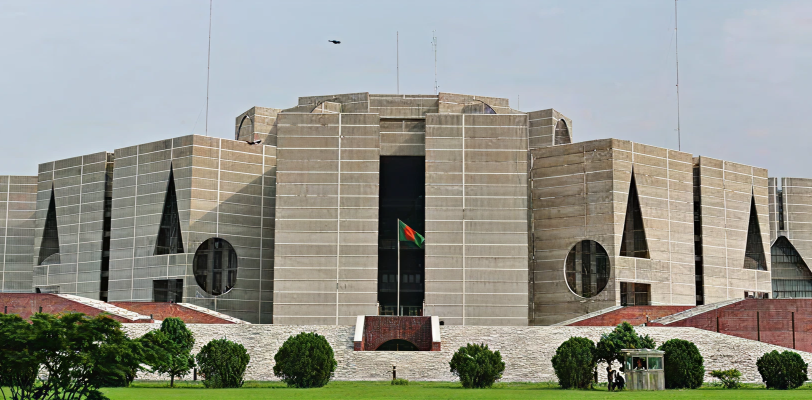

Construction Period
1962 – 1982

Location
Sher-e-Bangla Nagar, Dhaka

Capacity
354 Members + Galleries
The Visionary Architect
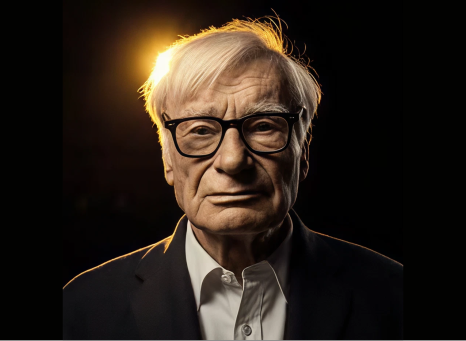
Louis Isadore Kahn (1901–1974)
Louis Isadore Kahn was an American architect based in Philadelphia, renowned for his transcendent and visionary approach to architecture. He created monumental buildings based on his personal philosophy of 'Silence and light'. His work represented a profound understanding of the intersection between human life and the cosmos.
Architectural Philosophy
Famous for his monumental brick works and use of natural materials, Kahn architected structures that celebrate the nature of human experience. He was one of the most significant architects of the 20th century, receiving prestigious awards including the AIA Gold Medal and the RIBA Gold Medal.
Documentary Recognition
The building was featured prominently in the Academy Award-winning documentary “My Architect”, which explored the name and legacy of Louis I. Kahn and his architectural achievements.
Parliamentary History
From the Old Parliament House to the modern architectural marvel designed by Louis I. Kahn
Constituent Assembly
1972 - 1973
The Constituent Assembly of Bangladesh held their first sittings in the building that now houses the Prime Minister's office, known as the Old Parliament House.
Transition Period
1981 - 1982
The second Parliament held most of its sittings in the old building, with the last sitting on July 10, 1981. During this tenure, plans for the new building were finalized.
New Era
February 15, 1982
The last session of Parliament commenced on February 15, 1982, in the new building at Sher-e-Bangla Nagar, marking a new chapter in Bangladesh's democratic journey.
Location & Boundaries
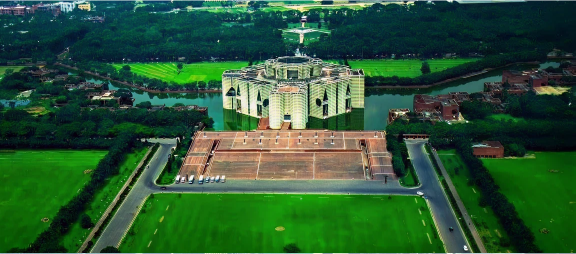
The Parliament complex is strategically located at Sher-e-Bangla Nagar, bounded by Rokeya Sarani to the west, Manik Mia Avenue to the south, Lake Road to the north, and Mirpur Road to the east. The complex spans approximately 215 acres, featuring the main Parliament Building, residential facilities, and beautifully landscaped areas.
- Total Area
215 acres of carefully planned complex
- Building Area
6.5 acres of marble building structure
- Facilities
Hostel, lakes, and landscaped gardens
Architectural Design Philosophy
The design of the Bangladesh National Parliament Building (Jatiyo Sangsad Bhaban) reflects a deep respect for human needs, civic identity, and democratic authority. Architect Louis I. Kahn envisioned a monumental structure rooted in simplicity and symbolism, where massive geometric forms express strength and unity. The interplay of concrete and light, shaped by large geometric openings, creates distinctive visual characteristics while allowing natural illumination to define the interior’s spiritual and functional depth.
Surrounded by a serene water body, the complex embodies harmony between nature, culture, and authority. The central assembly hall stands as a sanctuary of deliberation — monumental yet humane. Beyond architecture, the building serves as a timeless symbol of Bangladesh’s democratic spirit, where light, space, and material together represent the ideals of transparency, order, and unity.
Parliamentary Chamber
Chamber Details
The Parliament Chamber has a seating capacity of 354 members plus podium and VIP galleries. The Chamber features a minimum height of 117 feet with seating spread across a 66-foot plan. A distinctive feature is the staircase above the parliament shell that allows natural daylight to filter through.
A composite chandelier consisting of a metallic web supports individual light fixtures, suspended from the parabolic shell. The hexagonal shape of the Parliament Chamber demonstrates the architectural harmony with the surrounding environment.
Facility Components
Ground Level
- •Main mechanical plant room
- •Car parking facilities
- •Main conference rooms
- •Restaurant facilities
- •Equipment stores
- •Open plaza with ramps
Upper Levels
- •Visitors and press galleries
- •Communication booths
- •Audio lounges (Level 7)
- •Library facilities
- •MP lounges
- •Party rooms (Level 8)
Additional Features
Administrative
- •Parliament Secretariat offices
- •Standing Committee rooms
- •Ministers' offices
- •Standing Committee chairs
Public Facilities
- •Information center
- •Gallery spaces
- •Open concourse
- •Visitor reception areas
Complex Components
- •South Plaza
- •Presidential Plaza
- •Main building structure
- •Landscaped gardens